
1
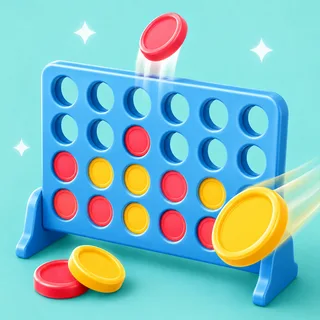
Take turns dropping a disc into a column.
You pick the column, not the square — the disc falls to the lowest empty slot, and turns swap red, yellow, red.
Drop discs to connect four.
Four in a row with real gravity — the drop, the plan, the groan when it's blocked. Instant strategy for two players or two very invested teams.
Also known as: connect four · four in a row
That's the goal — no rules to teach. Here's how a round of Drop4 runs.
You pick the column, not the square — the disc falls to the lowest empty slot, and turns swap red, yellow, red.
Across, down, or either diagonal — the first to line up four of their colour wins, and the run lights up on the board.
Every disc you drop does double duty: build your own four while you plug the gap in theirs. The best move often does both.
The same instant board is a one-on-one duel, a class-versus-class showdown, or a winner-stays-on ladder. Pick the room you've got — there's nothing to build first.
Two players, one screen — a tablet at a station or the board up front. They take turns dropping discs, and the winner is declared on the spot. The two-minute duel that settles who goes next.
One shared screen · pass and playProject one board and split the room in two. Each side calls its column and you (or the kid whose turn it is) drops the disc — the whole class leaning in on every move. No devices, no codes.
Zero devices · zero prepRun a ladder at indoor recess: the winner keeps the seat, the next challenger steps up, and a queue of kids stays happily busy. One projector, one line, zero refereeing from you.
One queue · runs itselfThere's nothing to read and no content to prep — but under one simple rule sits real strategy. Line up four four ways, spot the block, set the double threat — and no two games play out the same.
Same three-rule game, endless positions — the reason a five-year-old and a fifth-grader can both walk away wanting a rematch.
The Arcade is a shelf of classroom games that all launch the same way — a big screen or a shared device, and never a student account. Drop4 is the one that asks nothing of you first: no topic, no list, no setup. It's on the board and the first disc can fall ten seconds later.
Drop4 is the one you reach for when the plan runs short and the room needs a reset — no marking, no login, no setup, just a fast, fair duel everyone already knows how to play.
Rainy-day recess, sorted. Put a winner-stays-on ladder on the projector and a queue of challengers runs itself — you get five minutes back and nobody's climbing the walls.
Between two heavy activities, one quick duel resets the room. It needs no explaining — every kid already knows four-in-a-row — so you go from restless to playing in seconds.
Beat the teacher, or two teams for bragging rights. A single game is short enough to be the carrot at the end of a lesson, and just competitive enough to earn it.
Every Arcade game starts from the same box: type what you're teaching and the content writes itself — questions, words, clues — ready for the board at the front of the room.
Game types in the Arcade — one topic box fills them all
From typing a topic to pressing play
Student accounts — a code and a first name is the whole login
Steps every time: type it, check it, play it
I typed 'the water cycle' and had a class quiz in ten seconds flat. It's the first tool my whole department adopted.
Two players per game — or split the class into two teams and let each side vote on its next column.
No. One shared screen does it — pass-and-play on the projector, a tablet, or any browser.
Nothing. There's no content to write — drop it on the board and the first disc can fall ten seconds later.
Yes. Drop4 is included on Boardee's free tier, like every game type.
Never. Students join with a code and a name — no emails, no passwords. Teachers don't need an account to try it either.
Same three steps, different game. Type a topic and pick your shape.
Type it in, check the content, press play. The Arcade does the rest.